
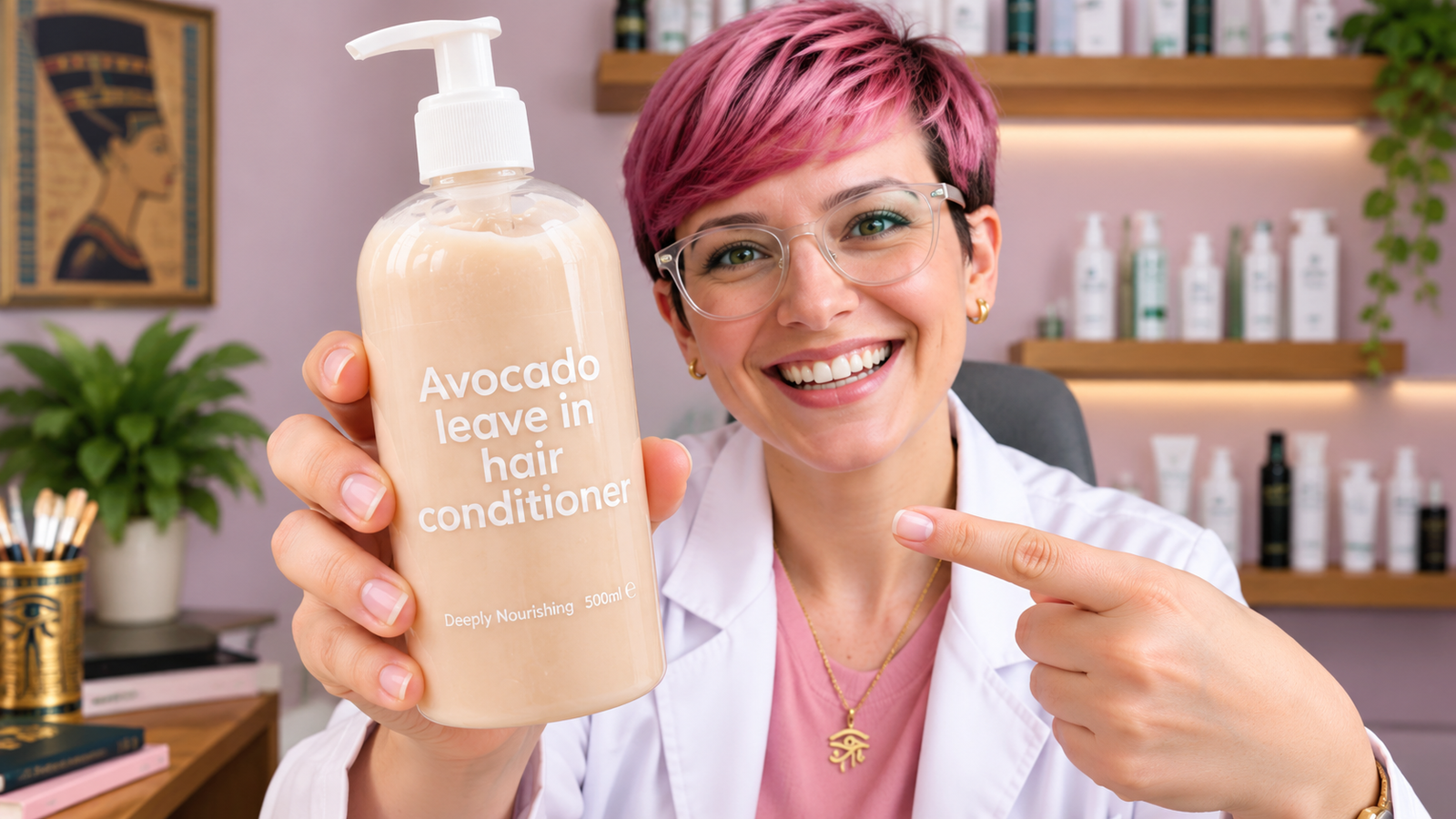
Leave-In Avocado Hair Cream Recipe for Detangling & Frizz Control
Mothers and caregivers often face a major daily challenge: struggling to comb and style children’s hair during busy school mornings. Tangles, knots, frizzy strands, and split ends cause discomfort and delays when trying to catch the school bus. Finding a lightweight, safe, and deeply hydrating daily hair styling cream is the ultimate solution to this universal problem.
In modern hair care formulation, combining natural plant gels, botanical hydrosols, cationically charged emulsifying waxes, and nutrient-dense fruit oils allows formulators to craft professional-grade hair care products at home or in a lab.
This comprehensive cosmetic guide details how to create a lightweight DIY Leave-in Avocado Hair Cream & Detangler. Engineered to neutralize static electricity, reduce friction between hair fibers, prevent moisture loss, and smooth out stubborn knots without leaving a greasy or sticky residue, this formula is ideal for formulators and small-business owners looking to expand their commercial organic beauty catalog.
The Science of Hair Tangles and Frizz
Understanding why hair gets tangled and frizzy is essential for formulating effective hair treatments.
- Static Electricity & Negative Charges: Damaged, dry, or chemically treated hair carries a net negative electrical charge. This causes individual hair strands to repel each other and float, resulting in unmanageable frizz and static flyaways.
- Friction and Cuticle Damage: When the outer layer of the hair shaft (the cuticle) becomes dry or lifted, strands catch on one another, creating stubborn knots. Forcing a comb through these knots without lubrication leads to mechanical breakage and split ends.
- Moisture Loss: Lack of internal hydration makes hair fibers rigid and brittle, increasing susceptibility to environmental stressors like wind, humidity, and heat.
By combining cationic emulsifiers, natural slip-providing gels, and nourishing plant lipids, our formulation targets each of these mechanisms to leave hair silky, manageable, and protected all day.
Key Active Ingredients & Their Cosmetic Benefits
Every raw material in this avocado leave-in hair lotion serves a specific therapeutic and structural purpose:
1. Fresh Flaxseed Gel (Linum Usitatissimum)
Flaxseed gel provides incredible natural slip, wrapping each hair fiber in a flexible, hydrating shield. It smooths down raised cuticles, making detangling effortless without breaking delicate hair fibers. Furthermore, flaxseed gel seals moisture inside the hair shaft without leaving white flakes or stiff residue once dry, making it ideal for straight, wavy, and curly hair types.
2. Aloe Vera Hydrosol (Aloe Barbadensis Floral Water)
Loaded with antioxidant vitamins, mineral salts, and soothing phytonutrients, Aloe Vera Hydrosol calms sensitive or irritated scalps. It provides lightweight aqueous hydration and imparts a refreshing, naturally soothing aromatic note to the finished cosmetic product.
3. Avocado Oil & Avocado Butter (Persea Gratissima)
Avocado oil and butter are rich in monounsaturated fatty acids (specifically oleic acid), essential vitamins A, D, and E, and natural phytosterols. Unlike heavy mineral oils, avocado lipids penetrate the hair shaft deeply to restore lipid loss, prevent moisture evaporation, and deliver long-lasting softness and radiant shine.
4. BTMS-50 (Behentrimonium Methosulfate & Cetearyl Alcohol)
BTMS-50 is a cationic (positively charged) emulsifying wax derived from colza oil. Because hair carries a negative charge, the positively charged quaternary ammonium compounds in BTMS-50 adsorb onto the hair shaft, neutralizing static charges, eliminating frizz, and imparting a velvety, conditioned feel without heavy build-up.
5. D-Panthenol (Pro-Vitamin B5)
Panthenol is a humectant that penetrates deep into the hair cortex, increasing moisture retention and boosting fiber elasticity. It forms a uniform protective film over hair shafts, helping hair endure daily mechanical stresses like combing and environmental exposure.
6. Guar Gum (Cyamopsis Tetragonoloba) & Butylene Glycol
Guar gum acts as a natural rheology modifier and film-former that stabilizes the lotion texture, while Butylene Glycol acts as a co-solvent and humectant, enhancing spreadability and maintaining hair hydration over extended periods.
7. Vitamin E (Tocopherol) & Broad-Spectrum Preservative
Tocopherol acts as a lipid-soluble antioxidant to preserve delicate avocado oils from oxidation, while a broad-spectrum preservative is required to protect the water-rich formula from mold, yeast, and bacterial contamination.
Professional Formulation Table (100g Batch)
Cosmetic formulations rely on weight measurements (grams) rather than volumetric measurements (milliliters) to ensure accuracy, consistency, and stability.
| Phase | Raw Material / Ingredient | Function | Percentage (%) | Weight for 100g Batch |
| Phase A | Distilled Water (for Flaxseed Gel) | Primary Solvent | 42.5% | 42.5 g |
| Phase A | Flaxseed Seeds (for Gel extraction) | Slip Agent / Film Former | 0.5% | 0.5 g |
| Phase A | Aloe Vera Hydrosol | Hydrating / Soothing Base | 35.0% | 35.0 g |
| Phase A | Butylene Glycol | Humectant / Co-Solvent | 4.0% | 4.0 g |
| Phase A | Guar Gum | Thickener / Texture Stabilizer | 0.5% | 0.5 g |
| Phase B | BTMS-50 Wax | Cationic Emulsifier & Conditioner | 5.0% | 5.0 g |
| Phase B | Cetyl Alcohol | Co-Emulsifier & Viscosity Builder | 3.0% | 3.0 g |
| Phase B | Avocado Oil | Emollient / Nutrient Provider | 4.0% | 4.0 g |
| Phase B | Avocado Butter | Rich Lipid / Sealant | 2.0% | 2.0 g |
| Phase C | D-Panthenol (Pro-Vitamin B5) | Deep Hydrator / Elasticity Booster | 1.0% | 1.0 g |
| Phase C | Broad-Spectrum Preservative | Anti-Microbial Protection | 1.0% | 1.0 g |
| Phase C | Vitamin E (Tocopherol) | Lipid Antioxidant | 0.5% | 0.5 g |
| Phase C | Fragrance Oil / Essential Oil | Aromatic Enhancement | 0.5% | 0.5 g |
| Phase C | Citric Acid Solution (10%) | pH Adjustment Agent | q.s. | q.s. |
| Total | 100.0% | 100.0 g |
Essential Laboratory & Manufacturing Equipment
To maintain commercial standards and hygiene during production, prepare the following laboratory equipment:
- Digital precision scale (0.01g accuracy)
- Heat-resistant borosilicate glass beakers (250ml & 500ml)
- Double-boiler set (Water Bath setup)
- High-shear stick blender / Hand blender
- Stainless steel strainers / Fine cloth filters
- Silicone spatulas and glass stirring rods
- Digital pH meter or precise pH indicator strips
- Sanitized lotion pump bottles (dispenser type)
- Personal Protective Equipment (PPE): Nitrile gloves, face mask, head cover, and clean lab apron
- 70% Isopropyl Alcohol spray for sanitizing surfaces and tools
Step-by-Step Manufacturing Instructions
Step 1: Sanitation & Prep
Clean and sanitize your entire workstation. Spray all beakers, silicone spatulas, blender blades, and packaging containers with 70% Isopropyl Alcohol. Allow them to air dry completely. Don your lab coat, head cover, mask, and nitrile gloves.
Step 2: Extraction of Fresh Flaxseed Gel
- In a clean pot, combine 100g of Distilled Water with 7g of whole Flaxseed Seeds (maintaining a 100:7 ratio).
- Heat over medium flame until boiling, letting it simmer gently for 10 minutes until a clear, slippery gel forms.
- Remove from heat, allow it to cool, and filter the gel through a fine mesh strainer into a sterile container.
- Weigh out exactly 42.5g of the prepared flaxseed gel into your Phase A beaker.
Step 3: Preparing Phase A (Aqueous Phase)
- Add 35.0g of Aloe Vera Hydrosol to the beaker containing the extracted flaxseed gel and stir thoroughly.
- In a small separate cup, slurry the 0.5g of Guar Gum into 4.0g of Butylene Glycol until smooth and clump-free.
- Pour the slurry into the flaxseed and aloe mixture.
- Blend the aqueous mixture using a stick blender for 1–2 minutes until a uniform gel base is achieved. Cover with foil and set aside.
Step 4: Preparing Phase B (Oil & Emulsifier Phase)
In a secondary dry beaker, combine all oil-phase components:
- 5.0g BTMS-50
- 3.0g Cetyl Alcohol
- 4.0g Avocado Oil
- 2.0g Avocado Butter
Step 5: Heating and Emulsification
- Place both Phase A and Phase B beakers into a water bath (double boiler) set to approximately 70°C–75°C (158°F–167°F).
- Heat until all waxes and butters in Phase B are completely melted and fluid.
- Remove both beakers from the heat bath. Slowly pour the melted Phase B (Oil Phase) into Phase A (Water Phase) while blending continuously with a hand blender on medium speed.
- A smooth, glossy, light milky emulsion (lotion) will form immediately. Continue intermittent blending while cooling.
Step 6: Cool-Down Phase & Active Additions (Phase C)
- Allow the cream to cool down below 40°C (104°F) before adding heat-sensitive active ingredients. Stir gently with a spatula periodically to prevent phase separation.
- Once cooled, add 1.0g of D-Panthenol, 1.0g of Broad-Spectrum Preservative, 0.5g of Tocopherol (Vitamin E), and 0.5g of Fragrance Oil.
- Mix thoroughly for 3 minutes until completely homogenous.
Step 7: Testing & Adjusting pH
- Take a small sample of the finished cream and measure the pH using a digital pH meter or calibrated pH strips.
- The optimal pH range for a leave-in hair conditioner/detangler is 5.0 to 5.5. This acidic pH seals hair cuticles and matches the natural pH of the scalp.
- If the pH is higher than 5.5, add a few drops of a 10% Citric Acid solution, stir thoroughly, and re-test until the target range is achieved.
Step 8: Packaging & Storage
Transfer the light avocado cream into sanitized pump-dispenser bottles. Bottle packaging is preferred over open jars to protect liquid leave-in formulations from atmospheric contamination. Label the product with manufacturing date, batch number, and usage directions.
Daily Application & Usage Guide
To maximize detangling efficacy and prevent daily hair damage:
- Dispense: Pump a small coin-sized amount of lotion onto palms.
- Apply: Work the product through damp or dry hair, focusing primarily on mid-lengths and ends where knots and dryness occur.
- Detangle: Gently comb through the hair starting from the ends and moving upward toward the roots using a wide-tooth comb.
- Style: Leave product in—do not rinse out. Style hair as desired into braids, ponytails, or natural waves.
Frequently Asked Questions (FAQ)
Can I replace BTMS-50 with non-cationic emulsifying waxes like Polawax?
While non-cationic emulsifying waxes will emulsify water and oil, they lack the positive electrical charge required to neutralize static buildup on hair fibers. BTMS-50 is necessary for proper conditioning, slip, and anti-frizz performance.
How long does this DIY leave-in cream last?
Formulated with 1.0% broad-spectrum preservative at a pH of 5.0–5.5, this cream has an estimated shelf life of 6 to 12 months when stored at room temperature away from direct sunlight.
Is this product safe for toddlers and children?
Yes! The formula utilizes gentle botanical extracts, non-comedogenic plant lipids, and soothing aloe hydrosol, making it exceptionally suited for children struggling with daily morning detangling routines.
Conclusion
Formulating a Leave-In Avocado Hair Cream & Detangler provides a professional solution to morning hair tangles, static frizz, and breakage. By combining nature-derived conditioning agents with proven cosmetic active ingredients, formulators can produce high-value, salon-grade hair care products at home