
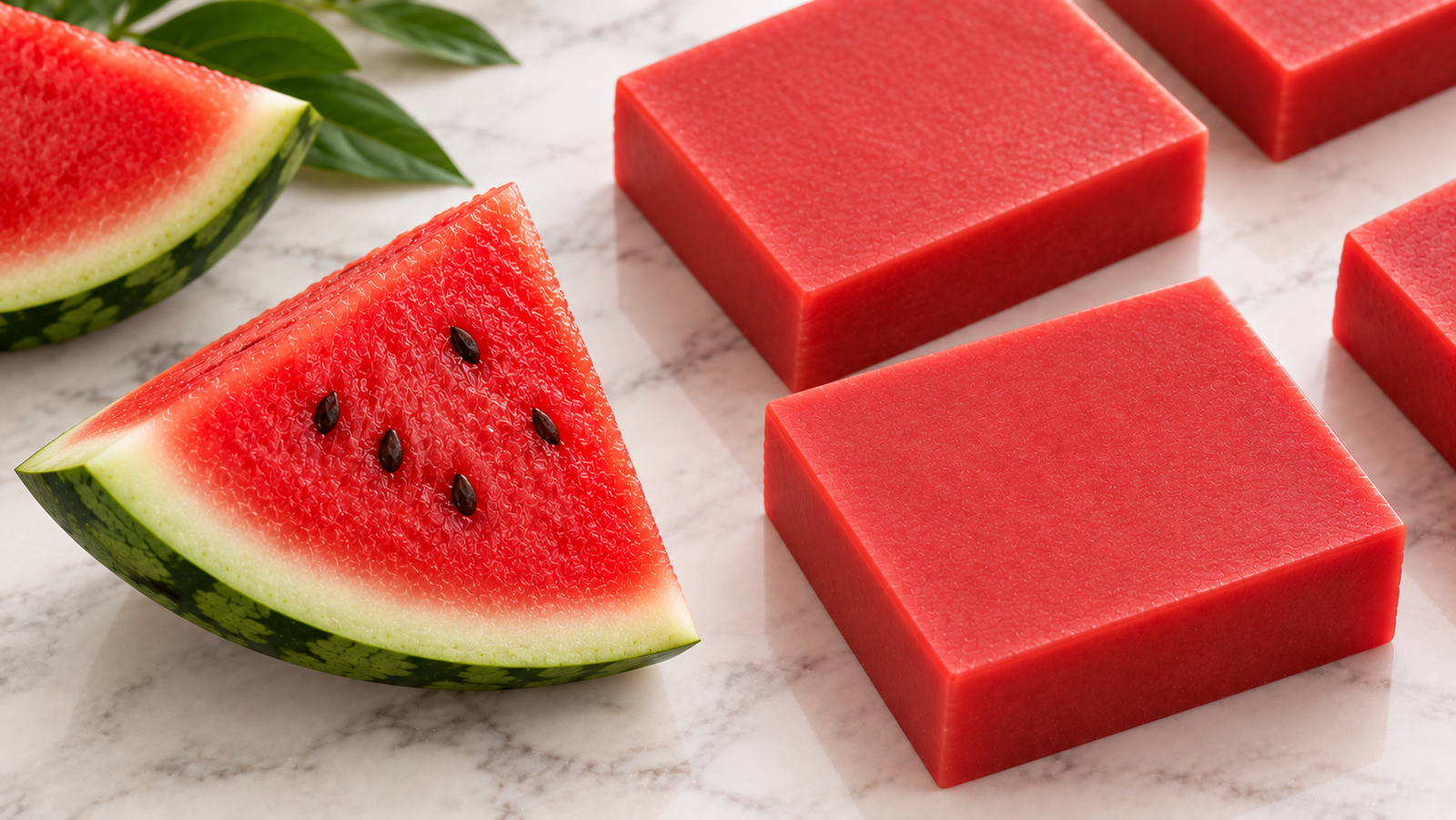
Cold Process Watermelon Soap for Korean Glass Skin
The trend toward achieving “Korean Glass Skin”—a complexion characterized by deep hydration, smooth texture, poreless appearance, and a clear, luminous glow—has driven demand for botanical formulations rich in natural phytonutrients. While many commercial cleansing bars rely on synthetic detergents and harsh sulfates that strip the skin’s protective moisture barrier, artisanal cold process soap making leverages fresh fruit juices, unrefined plant oils, and nutrient-dense butters to achieve deep cleansing alongside restorative nourishment.
Fresh watermelon juice (Citrullus lanatus) serves as an exceptional functional ingredient in cold process soap making. Packed with lycopene, Vitamin C, Vitamin A, and essential amino acids, fresh watermelon acts as a natural astringent, antioxidant powerhouse, and cellular revitalizer.
This detailed cosmetic manufacturing guide covers the chemical properties, fatty acid profiles, and step-by-step procedure for formulating a high-performance Commercial Cold Process Watermelon Soap Bar.
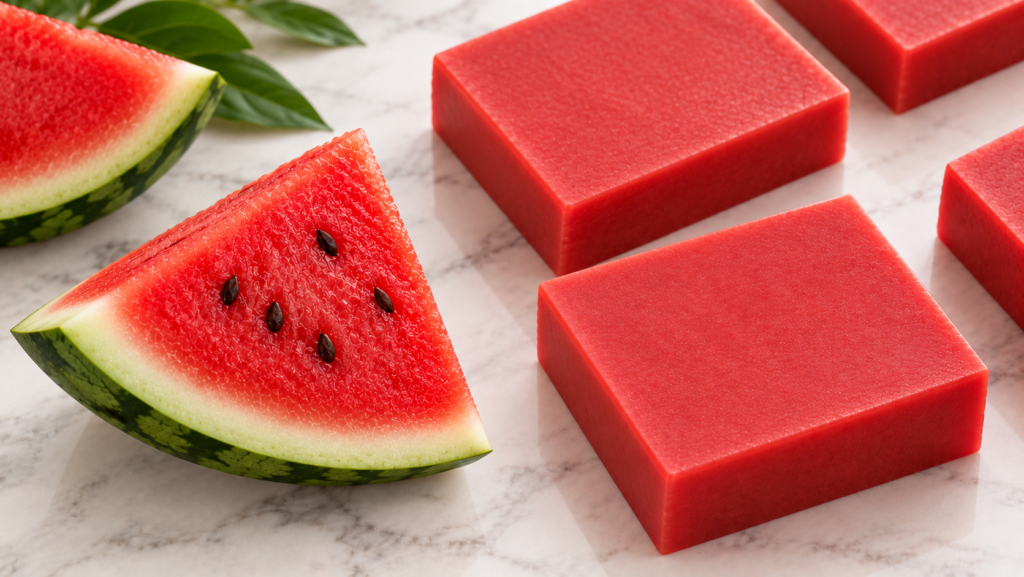
Phytochemistry & Skin Benefits of Natural Watermelon Juice
Formulating soap with fresh botanical juice requires a thorough understanding of its active compounds and their behavior during saponification.
1. Lycopene & Carotenoids
Watermelon is one of the richest natural sources of lycopene, a potent carotenoid antioxidant. Lycopene neutralizes singlet oxygen free radicals generated by solar radiation and atmospheric pollution, helping prevent lipid peroxidation, skin darkening, and premature collagen damage.
2. Vitamin C (L-Ascorbic Acid) & Vitamin A
- Vitamin C: Supports collagen synthesis, brightens uneven skin tone, and restores natural radiance to tired, dull skin.
- Vitamin A (Beta-Carotene): Promotes cellular turnover, aids in gentle epidermal exfoliation, and helps maintain smooth skin texture.
3. Natural Sugars & Amino Acids (Citrulline)
- Citrulline: An essential amino acid found abundantly in watermelon rind and juice. It conditions the skin, improves circulation, and helps protect structural proteins.
- Fructose & Glucose: Natural sugars in fruit juice boost soap lather, turning cold process soap foam into a rich, velvety lather.
4. Natural Astringency & Pore Refinement
The natural organic acids and high potassium content in fresh watermelon juice help tone enlarged pores, balance excess surface oil, and soothe thermal skin inflammation during warm seasons.
Fatty Acid Profile & Structural Balance
To balance the high lather potential created by fruit sugars, the oil phase is structured with precise proportions of hard butters and nourishing oils.
- Olive Oil (Olea Europaea): High in Oleic Acid (C18:1). Provides deep hydration, skin elasticity, and an ultra-gentle cleansing action ideal for sensitive skin.
- Coconut Oil (Cocos Nucifera): High in Lauric Acid (C12:0) and Myristic Acid (C14:0). Delivers solid bar hardness, high solubility, and abundant cleansing bubbles.
- Shea Butter (Butyrospermum Parkii): Rich in Stearic Acid (C18:0) and unsaponifiable compounds. Generates a creamy, lotion-like lather and fortifies the lipid barrier against moisture loss.
- Cocoa Butter (Theobroma Cacao): High in Palmitic and Stearic fatty acids. Adds structural integrity, prevents premature bar erosion in wet conditions, and leaves a silky post-wash feel.
- Castor Oil (Ricinus Communis): Rich in Ricinoleic Acid (C18:1-OH). Acts as a foam stabilizer, sustaining micro-bubbles and providing humectant properties.
- Sweet Almond Oil (Prunus Amygdalus Dulcis): Rich in Linoleic and Oleic acids. Offers lightweight nourishment, soothing dryness and enhancing skin smoothness.
Complete Master Formulation (Batch Weight & Proportions)
All ingredients are measured strictly by mass (grams) to ensure precise stoichiometric saponification.
1. Watermelon Juice & Lye (Sodium Hydroxide) Phase
| Ingredient / Component | Functional Role | Weight for Batch |
| Fresh Watermelon Fruit (Base Raw Material) | Juice Extraction Source | ~300.0 g |
| Frozen Fresh Watermelon Juice | Lye Solvent (Ice Cubes) | 276.0 g |
| Sodium Hydroxide (NaOH / Lye) | Saponification Agent | 168.2 g |
Critical Safety Note: Fresh watermelon juice MUST be strained to eliminate pulp and frozen into solid ice cubes prior to lye addition. This controls the exothermic reaction temperature and prevents sugar scorching.
2. Lipid Phase (Oils & Butters)
| Lipid Raw Material | Fatty Acid Contribution | Weight (Grams) |
| Olive Oil | Oleic Acid / Moisture Base | 540.0 g |
| Coconut Oil | Lauric Acid / Cleansing & Lather | 384.0 g |
| Shea Butter | Stearic Acid / Creamy Texture | 144.0 g |
| Cocoa Butter | Hardness & Structural Stability | 48.0 g |
| Castor Oil | Ricinoleic Acid / Lather Stabilizer | 48.0 g |
| Sweet Almond Oil | Essential Fatty Acids / Smoothness | 36.0 g |
| Total Oils & Butters | 1200.0 g |
3. Aesthetics, Colorants & Fragrance Phase
| Additive | Role / Function | Weight / Quantity |
| Red Mica Powder | Aesthetic Color Dispersion | 0.5 teaspoon (in 1 tbsp Almond Oil) |
| Watermelon Skin-Safe Fragrance Oil | Sensory Fragrance Accent | 36.0 g (3.0% of oil weight) |
Equipment & Personal Safety (PPE)
Handling Sodium Hydroxide requires strict adherence to laboratory safety protocols:
- Heavy-duty chemical resistant gloves (Nitrile/Neoprene)
- Safety goggles or full-face shield
- Respiratory mask (for lye powder handling)
- Digital laboratory scale (0.1g accuracy)
- Immersion stick blender with stainless steel shaft
- Heavy-duty heat-resistant polypropylene or stainless steel mixing vessels
- Digital infrared thermometer
- Flexible silicone loaf or cavity molds
- Stainless steel soap cutter or bench scraper
Step-by-Step Manufacturing Protocol
Step 1: Juice Extraction & Freezing (Pre-Preparation Phase)
- Chop approximately 300g of fresh, seedless watermelon flesh. Puree in a high-speed blender without adding any water.
- Strain the puree through a fine mesh strainer or cheesecloth to remove all solid pulp and fiber.
- Weigh out exactly 276g of pure watermelon juice.
- Pour the juice into silicone ice cube trays and place in the freezer until completely frozen solid.
Step 2: Sanitation & Lipid Phase Preparation
- Sanitize all working surfaces, mixing vessels, spatulas, and silicone molds using 70% Isopropyl Alcohol.
- Put on protective goggles, gloves, and a long-sleeved shirt.
- Weigh the Shea Butter (144g) and Cocoa Butter (48g) into a heat-resistant pot. Gently melt over a low double boiler.
- Once melted, remove from heat and blend in the Olive Oil (540g), Coconut Oil (384g), Castor Oil (48g), and Sweet Almond Oil (36g). Set aside to cool.
Step 3: Preparing the Lye-in-Juice Solution
- Place the 276g of Frozen Watermelon Juice Ice Cubes into a heavy-duty, heat-resistant plastic pitcher placed in a well-ventilated area.
- Weigh out 168.2g of Sodium Hydroxide (NaOH).
- Slowly sprinkle small amounts of Sodium Hydroxide over the juice ice cubes while stirring continuously with a heat-resistant spatula.
- Technique Tip: Adding lye gradually prevents the natural fruit sugars from overheating and caramelizing. Continue stirring until all ice cubes are completely melted and all lye crystals are dissolved. The solution will take on an orange-coral tone.
Step 4: Emulsification & Reaching Trace
- Measure temperatures using an infrared thermometer. Ensure both the oil mixture and the lye-juice solution are cooled to a close temperature range (around 30°C to 38°C / 86°F to 100°F).
- Pour the lye-juice solution through a stainless steel strainer into the melted oils.
- Submerge the stick blender, burp out trapped air bubbles, and pulse on low speed. Alternate between short pulses and manual stirring.
- Continue until the mixture reaches a light trace (a smooth batter consistency where drizzled soap leaves a faint surface trail).
Step 5: Color Dispersion & Fragrance Addition
- Disperse 0.5 teaspoon of Red Mica Powder into 1 tablespoon of Sweet Almond Oil. Add this mixture to the soap batter and blend briefly to achieve a rich watermelon shade.
- Pour in 36g of Watermelon Fragrance Oil and hand-stir thoroughly using a silicone spatula to prevent premature batter acceleration.
Step 6: Pouring & Temperature Regulation (Preventing Gel Phase)
- Pour the soap batter smoothly into sanitized silicone molds. Tap the mold firmly on the counter to eliminate trapped air pockets.
- Crucial Formulation Rule (Gel Phase Prevention): Unlike traditional cold process soaps, fruit juice soaps containing high natural sugar levels should NOT be insulated or kept in a warm environment. Overheating can cause sugar caramelization, turning the soap dark brown and damaging its appearance.
- Place the filled soap mold immediately in a cool room, air-conditioned environment, or even the refrigerator for the first 12 to 24 hours to control the thermal reaction.
Step 7: Unmolding, Slicing & Curing
- After 24 hours, unmold the hardened soap loaf.
- Slice into uniform bars using a stainless steel soap cutter.
- Transfer the bars to open wooden or plastic drying racks in a well-ventilated, dry room out of direct sunlight.
- Allow the bars to cure for 6 weeks. This extended cure allows full water evaporation and complete saponification, resulting in a gentle, firm bar with optimal pH balance.
Frequently Asked Questions (FAQ)
Why does watermelon juice soap need to be kept cool after pouring?
Watermelon juice contains high levels of natural sugars (fructose and glucose). When these sugars react with Sodium Hydroxide, they generate extra heat. If insulated, this excess heat causes caramelization and forces the soap into an uncontrolled gel phase, turning the bright bar dark brown. Keeping the mold cool preserves its vibrant color and smooth texture.
Can I use store-bought watermelon juice instead of fresh juice?
Commercial juices often contain added sugars, sodium benzoate, or artificial preservatives that can interfere with saponification and cause unpredictable batter acceleration or soft bars. Freshly extracted and strained juice yields the best results.
What is the recommended cure time for this soap?
A full 6-week cure period is strongly recommended for fruit juice cold process soaps. This ensures complete water evaporation, yields a harder bar that resists melting in the shower, and maximizes lather quality.
Conclusion
Formulating Cold Process Watermelon Soap offers a natural way to deliver antioxidant protection and deeply hydrating benefits in a solid cleansing bar. By carefully balancing hard fats, controlling lye temperatures with frozen juice cubes, and preventing sugar caramelization through thermal management, cosmetic formulators can craft a high-performance cleansing bar that promotes a clear, radiant, Korean glass skin complexion.