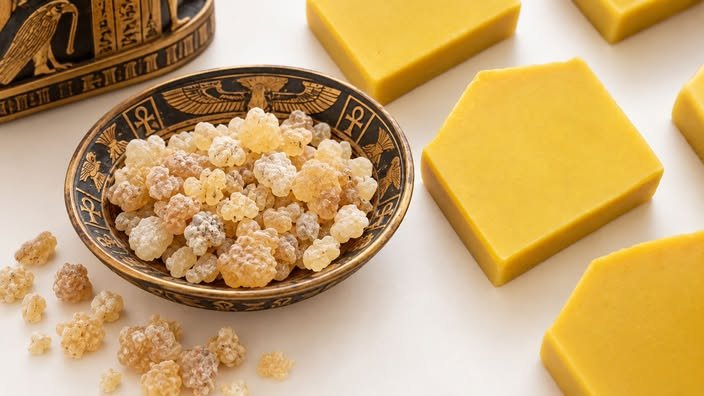
Cold Process Frankincense Soap Recipe: Natural Collagen Support
Cold process soap making is one of the most rewarding techniques in professional cosmetic formulation. Unlike melt-and-pour or commercial detergent bars that rely on synthetic surfactants, cold process saponification preserves the delicate bioactive compounds found in botanical infusions, unrefined fats, and cold-pressed plant oils.
Among specialized cold process bars, Frankincense and Licorice Soap (widely celebrated as the Natural Collagen Soap) stands out for its exceptional ability to firm sagging skin, reduce fine lines, fade dark spots, and restore radiant skin elasticity without causing dryness or barrier disruption.
This comprehensive formulation guide explores the dermatological benefits, active phytochemistry, chemical calculation, and step-by-step manufacturing process for formulating a high-end Commercial Frankincense & Licorice Cold Process Bar.
Phytochemistry & Skin Benefits of Key Actives
Understanding the biological mechanisms of botanical extracts helps cosmetic formulators craft targeted solutions for hyperpigmentation, collagen loss, and premature aging.
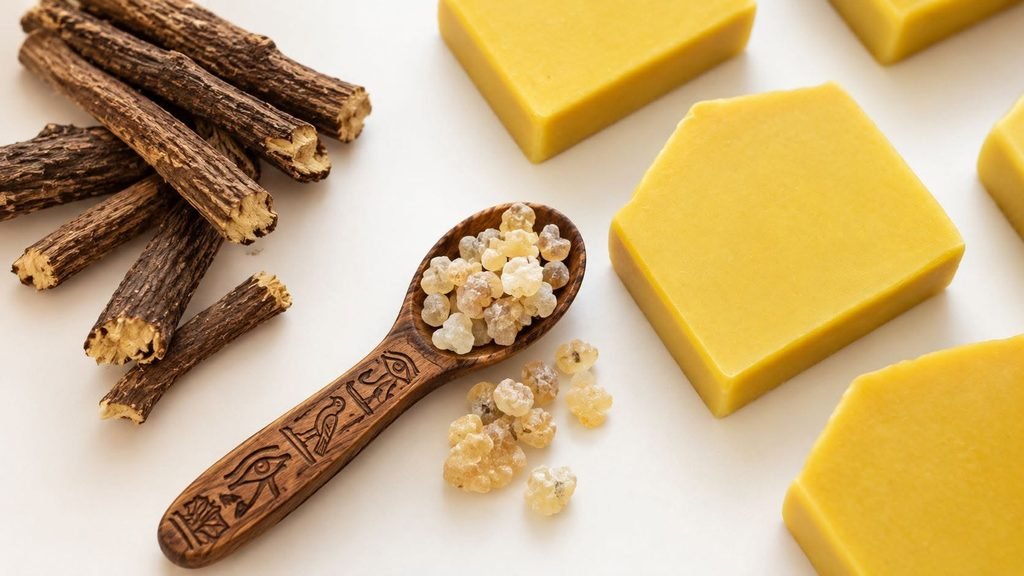
1. Frankincense Hydrosol & Resinous Infusion (Boswellia carterii)
Frankincense resin has been valued for centuries in traditional skincare for its potent astringent and skin-regenerating properties.
- Natural Collagen & Elasticity: The pentacyclic triterpene acids (boswellic acids) present in frankincense resin help inhibit pro-inflammatory enzymes (5-lipoxygenase), reducing tissue degradation and helping firm skin structure.
- Pore Refinement & Firming: Natural resins provide a mild astringent effect that minimizes enlarged pores, smooths surface texture, and gives a toned, lifted appearance.
- Soothing & Anti-Inflammatory: Calm skin irritation, balance reactive redness, and promote cellular renewal for a rejuvenated skin surface.
2. Licorice Root Oil Extract (Glycyrrhiza glabra)
Extracted into Sweet Almond Oil, licorice root is a premier botanical brightening active.
- Tyrosinase Inhibition: Licorice contains Glabridin, a powerful compound that inhibits tyrosinase activity—the primary enzyme responsible for melanin synthesis—thereby fading dark spots, sun spots, and post-inflammatory hyperpigmentation.
- Antioxidant Protection: Rich in flavonoids that neutralize free radicals generated by UV radiation and environmental pollution, preventing premature collagen degradation.
Fatty Acid Profile & Lipid Selection
A balanced cold process soap formula requires a strategic combination of hard fats, moisturizing oils, and lather boosters to achieve optimal hardness, creamy cleansing, and long-lasting skin hydration.
- Olive Oil (Olea Europaea): High in Oleic Acid (C18:1) and natural Vitamin E. Provides deep conditioning, gentleness, and skin protection against oxidative damage.
- Coconut Oil (Cocos Nucifera): Rich in Lauric Acid (C12:0) and Myristic Acid (C14:0). Essential for creating abundant, fluffy lather and providing strong cleansing performance.
- Cocoa Butter (Theobroma Cacao): High in Stearic and Palmitic acids. Adds significant bar hardness, prevents rapid dissolution in water, and forms a protective lipid barrier on the skin.
- Shea Butter (Butyrospermum Parkii): Packed with unsaponifiables, triterpenes, and essential fatty acids that promote skin barrier repair and yield a luxurious, lotion-like creamy lather.
- Castor Oil (Ricinus Communis): Unique for its Ricinoleic Acid content. Acts as a natural lather stabilizer and humectant, drawing moisture to the skin during cleansing.
- Sweet Almond Oil (Prunus Amygdalus Dulcis): Serves as the carrier for licorice extraction, nourishing the skin with Vitamin E and essential fatty acids.
Complete Master Formulation (Batch Weight & Proportions)
The following master recipe is formulated for a batch yielding rich lather, firm structural integrity, and exceptional skin-mildness.
1. Water & Lye (Sodium Hydroxide) Phase
| Ingredient | Cosmetic Function | Mass Weight (Grams) |
| Distilled Water (for Infusion) | Botanical Extraction Medium | 350.0 g |
| Frankincense Resin | Collagen Support / Firming Active | 26.5 g |
| Frozen Frankincense Tea (Yielded) | Lye Solvent (Ice Cubes) | 280.0 g |
| Sodium Hydroxide (NaOH / Lye) | Saponification Agent | 173.6 g |
Note: Freezing the Frankincense infusion into ice cubes before adding Sodium Hydroxide prevents the lye heat reaction from scorching delicate resin compounds, preserving their therapeutic benefits.
2. Oils, Butters & Lipid Phase
| Lipid / Oil Component | Fatty Acid Role | Mass Weight (Grams) |
| Olive Oil | Conditioning & Antioxidant Base | 504.0 g |
| Coconut Oil | Lather Generator & Cleansing Agent | 300.0 g |
| Cocoa Butter | Hardness & Barrier Protection | 216.0 g |
| Shea Butter | Skin Repair & Creamy Foam | 48.0 g |
| Castor Oil | Lather Booster & Humectant | 34.0 g |
| Licorice Oil Extract (in Sweet Almond Oil) | Brightening & Tyrosinase Inhibitor | 60.0 g |
| Total Oils & Butters | 1162.0 g |
3. Additives, Colorants & Fragrance
| Additive | Role | Usage Rate / Weight |
| Mica Powder (Dispersed in 1 tbsp Sweet Almond Oil) | Aesthetic Colorant | As desired |
| Essential Oils (Frankincense, Lavender, or Rose Geranium) | Therapeutic Scent / Active | 3.0% – 4.0% of total oil weight |
| Fragrance Oils (Alternative Cosmetic Grade) | Fragrance Accent | 2.0% – 3.0% of total oil weight |
Equipment & Personal Protective Equipment (PPE)
Cold process soap making involves handling Sodium Hydroxide (Lye), a strong alkaline compound. Safety gear and proper equipment are required:
- Chemical splash goggles or full face shield
- Heavy-duty nitrile or neoprene gloves (long cuffs)
- Respiratory mask (for powder handling and lye fumes)
- Digital scale (0.1g or 0.01g precision)
- Immersion blender (stick blender)
- Heat-resistant heavy-duty plastic or stainless steel pitchers
- Digital infrared thermometer
- Silicone loaf molds or individual cavity molds
- Soap cutter or stainless steel bench scraper
Step-by-Step Cold Process Manufacturing Protocol
Phase A: Preparing the Frankincense Ice Concentrate (24 Hours Prior)
- Bring 350g of Distilled Water to a gentle boil.
- Place 26.5g of coarsely cracked Frankincense Resin into a clean glass jar. Avoid grinding into a fine powder; small cracked pieces work best.
- Pour the boiling distilled water over the resin, seal tightly, and allow it to steep for 24 hours. Shake or stir the jar periodically to maximize bioactive extraction.
- After 24 hours, strain the liquid through a fine mesh strainer or cheesecloth. The liquid will appear milky white.
- Weigh out exactly 280g of the milk-white Frankincense tea, pour into silicone ice cube trays, and freeze completely.
Phase B: Disinfecting & Preparing the Oil Phase
- Disinfect all countertops, mixing vessels, and utensils with 70% Isopropyl Alcohol.
- Put on protective goggles, gloves, and a long-sleeved shirt.
- In a large heat-resistant pot or stainless steel container, weigh out Cocoa Butter (216g) and Shea Butter (48g). Heat gently over a double boiler until fully melted.
- Remove from heat and add Olive Oil (504g), Coconut Oil (300g), Castor Oil (34g), and Licorice Oil Extract in Sweet Almond Oil (60g). Stir well and set aside to cool.
Phase C: Preparing the Lye-In-Ice Solution
- In a well-ventilated area or under a fume hood, weigh 280g of Frozen Frankincense Ice Cubes into a heavy-duty heat-resistant plastic jug.
- Slowly pour 173.6g of Sodium Hydroxide (NaOH) directly over the ice cubes in small increments.
- Stir gently using a heat-resistant spatula. The exothermic reaction will gradually melt the ice cubes without burning the frankincense compounds. Continue stirring until all lye crystals are dissolved and the liquid is translucent and smooth.
Phase D: Emulsification & Reaching Trace
- Measure the temperature of both the lye solution and the melted oil mixture using an infrared thermometer. Ensure both phases are within a close temperature range (around 35°C to 45°C / 95°F to 113°F).
- Pour the lye solution through a strainer into the oil mixture to catch any undissolved particles.
- Submerge the stick blender to the bottom of the vessel, burp out trapped air bubbles, and pulse on low speed. Alternately pulse and stir manually.
- Continue until a light trace is achieved (when drizzled batter leaves a subtle trail on the surface).
Phase E: Colorant, Fragrance & Pouring
- In a small cup, disperse 1 tablespoon of Mica Powder into 1 tablespoon of Sweet Almond Oil until smooth. Add this dispersion to the soap batter and blend briefly.
- Add chosen Essential Oils (3%–4%) or Fragrance Oils (2%–3%) into the batter and hand-stir thoroughly with a spatula to prevent acceleration.
- Pour the soap batter into sanitized silicone loaf molds. Tap the mold firmly on the counter to eliminate air pockets.
Phase F: Saponification, Unmolding & Curing
- Insulate the soap mold with a towel or place it in a warm, draft-free space (such as an unheated oven) for 24 hours to complete initial saponification.
- After 24 hours, carefully unmold the soap loaf and slice into uniform bars using a soap cutter.
- Transfer the sliced soap bars to an open drying rack in a cool, well-ventilated room away from direct sunlight.
- Allow the bars to cure for 4 to 6 weeks. This curing period enables excess water to evaporate, yielding a hard, long-lasting bar with a mild pH suitable for facial and body skin.
Frequently Asked Questions (FAQ)
Why must the Frankincense infusion be frozen before adding lye?
Sodium Hydroxide generates high heat when mixed with water (often exceeding 90°C / 194°F). Pouring lye directly into liquid botanical infusions can scorch natural sugars and resins, creating an unpleasant odor and destroying delicate therapeutic actives. Freezing the infusion absorbs the heat energy safely.
How does Licorice Extract help with skin hyperpigmentation?
Licorice root contains Glabridin and Liquiritin, bioactive flavonoids that help inhibit melanin production by suppressing tyrosinase enzyme activity. Regular use helps fade dark spots, sun damage, and uneven skin tone.
Why is a 4 to 6 week cure time necessary?
During the cure period, two critical processes occur: full completion of the saponification reaction and the evaporation of excess water content. A fully cured soap bar is milder, creates better lather, and lasts significantly longer without softening quickly in water.
Conclusion
Formulating Cold Process Frankincense & Licorice Collagen Soap combines traditional botanical medicine with precise cosmetic chemistry. By combining resinous frankincense infusions, tyrosinase-inhibiting licorice extracts, and a balanced fatty acid profile, cosmetic formulators can craft a luxury cleansing bar that brightens, firms, and revitalizes the skin.