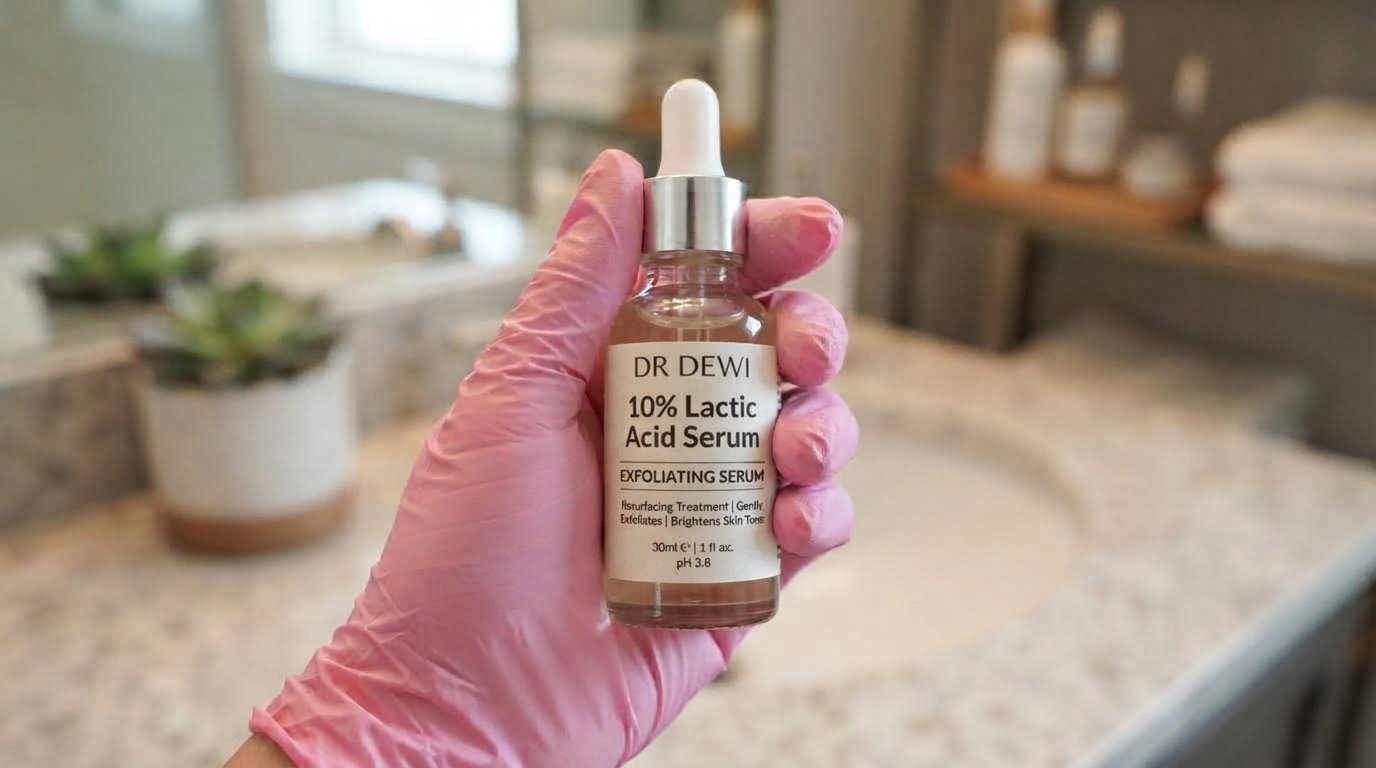
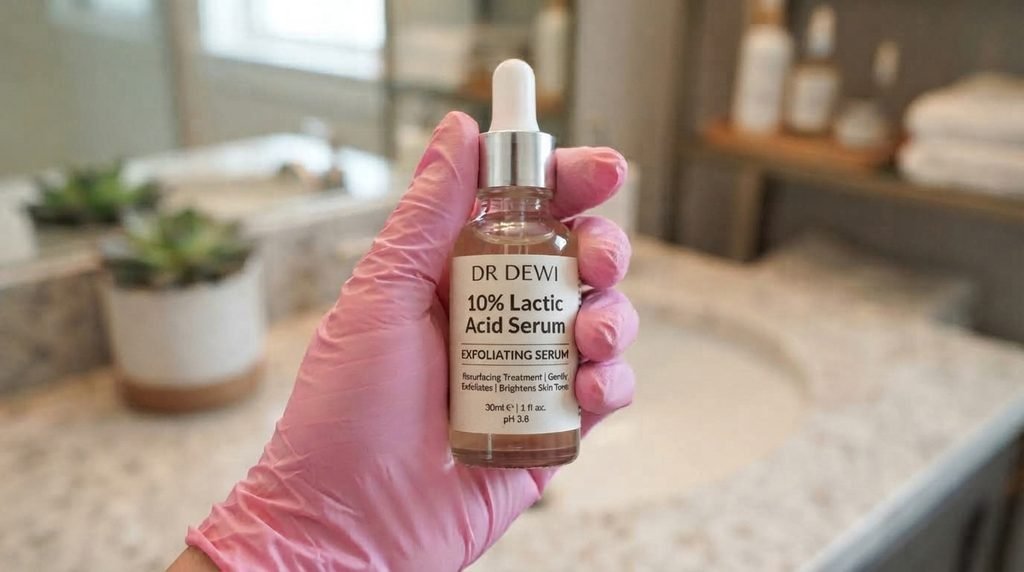
10% Lactic Acid Brightening Serum for Hyperpigmentation and Skin Renewal
Chemical exfoliation has revolutionized modern dermatological care and home cosmetic science. Among the broad family of Alpha Hydroxy Acids (AHAs), Lactic Acid is celebrated for its dual capability: providing thorough epidermal exfoliation while actively boosting skin hydration.
This comprehensive technical guide breaks down the formulation science, ingredient interactions, physiological benefits, and step-by-step laboratory procedures required to manufacture a stable, high-performance 10% Lactic Acid Serum.
1. The Chemistry and Biology of Lactic Acid
Lactic Acid ($C_3H_6O_3$) is an Alpha Hydroxy Acid derived naturally from sugar fermentation or synthesized for cosmetic consistency. Compared to Glycolic Acid, lactic acid has a higher molecular weight. This larger molecular size allows it to penetrate the stratum corneum more gradually, delivering effective exfoliation with a significantly lower risk of skin irritation.
Key Biological Actions:
- Accelerated Epidermal Renewal: Lactic Acid works by dissolving the desmosomes (protein bridges) that hold dead skin cells (corneocytes) together on the outermost layer of the skin. Shedding this dull layer exposes fresh, radiant skin underneath.
- Melanin & Hyperpigmentation Reduction: By speeding up cell turnover, hyperpigmented cells caused by sun exposure, post-inflammatory acne marks, or premature aging are shed faster, leading to an even skin tone.
- Fibroblast Stimulation: At optimal concentrations, Lactic Acid stimulates fibroblast activity within the dermis, encouraging the synthesis of collagen and elastin to improve structural elasticity and firm the skin.
- Humectant Action: Lactic Acid forms an integral part of the skin’s Natural Moisturizing Factor (NMF). It actively draws moisture into the skin while exfoliating, preventing the stripping sensation common with other acids.
2. Key Benefits of This Formulation
This targeted 10% Lactic Acid Serum delivers multiple cosmetic and therapeutic benefits:
- Evens Skin Tone & Fades Dark Spots: Directly targets post-acne marks, sun spots, and uneven pigmentation.
- Improves Texture: Smooths rough, bumpy skin texture through gentle, uniform micro-exfoliation.
- Anti-Aging & Antioxidant Defense: Stimulates structural proteins to reduce fine lines while neutralizing free radicals that accelerate premature aging.
- Soothes & Protects the Skin Barrier: Rich in anti-inflammatory botanical hydrosols and humectants that counteract potential redness or irritation.
3. Complete Master Formulation Table (100g Batch)
The following master formula outlines the precise percentages and batch weights for creating a balanced 100g sample.
| Phase | Ingredient | Function / Purpose | Percentage (%) | Weight for 100g Batch (g) |
| Phase A | Distilled Water | Pure Solvent / Formula Base | 69.60% | 69.60 g |
| Phase A | Panthenol (Vitamin B5) | Barrier Repair & Anti-Inflammatory | 2.00% | 2.00 g |
| Phase A | Sodium Lactate | pH Buffer & Humectant | 5.00% | 5.00 g |
| Phase A | Lactic Acid | Active Exfoliant & Cell Renewal | 10.00% | 10.00 g |
| Phase A | Aloe Vera Hydrosol | Soothing, Hydration & Antiseptic | 4.00% | 4.00 g |
| Phase A | Green Tea Hydrosol | Antioxidant & Anti-Acne Bacteria | 4.00% | 4.00 g |
| Phase A | Broad-Spectrum Preservative | Microbial Protection | 1.00% | 1.00 g |
| Phase B | Glycerin | Deep Humectant / Dispersant Base | 4.00% | 4.00 g |
| Phase B | Xanthan Gum | Natural Thickener & Gelling Agent | 0.40% | 0.40 g |
| Total | 100.00% | 100.00 g |
4. In-Depth Ingredient Breakdown
Distilled Water (69.6%)
Distilled water serves as the clean, mineral-free solvent for the water-soluble actives. Because it lacks dissolved minerals and metal salts, it prevents unwanted chemical oxidation and ensures long-term formula stability.
Panthenol / Vitamin B5 (2.0%)
Panthenol is a vital skin-repairing agent. It aids in restoring a compromised epidermal barrier, locks in moisture to prevent Trans-Epidermal Water Loss (TEWL), and calms any transient redness resulting from active acid exfoliation.
Sodium Lactate (5.0%)
Sodium Lactate serves a dual role in this formulation:
- pH Buffering: It acts as a primary buffering agent, preventing the acid pH from plummeting to unsafe levels that could cause chemical burns.
- Comfort & Hydration: It works synergistically with Lactic Acid to maintain skin softness, drastically reducing sting or burn sensations upon application.
Lactic Acid (10.0%)
The primary active exfoliant that drives cell renewal, stimulates collagen production, improves skin tone, and refines surface texture.
Aloe Vera Hydrosol (4.0%)
Extracted through steam distillation, Aloe Vera Hydrosol delivers light moisture along with natural antiseptic and soothing properties to calm sensitive or reactive skin.
Green Tea Hydrosol (4.0%)
Packed with polyphenols and green tea antioxidants, this hydrosol protects skin cells against free-radical damage induced by environmental stress. It also provides targeted antibacterial action against acne-causing bacteria (Cutibacterium acnes).
Glycerin (4.0%)
A classic polyol humectant that draws moisture from the atmosphere into the skin. In this process, it also acts as a vital dispersion vehicle for gelling gums.
Xanthan Gum (0.4%)
A natural polysaccharide created through glucose fermentation. At 0.4%, it builds a smooth, light serum-gel texture that glides across the skin without clogging pores or leaving an excessively tacky residue.
Broad-Spectrum Preservative (1.0%)
Ensures the water-rich environment remains entirely free from mold, yeast, and bacterial contamination throughout its shelf life.
5. Step-by-Step Manufacturing Protocol
Equipment & Preparation Requirements:
- Precision digital scale (0.01g sensitivity)
- Two clean, dry, sanitized glass beakers
- Immersion blender (stick blender)
- Digital pH meter or high-precision indicator strips
- Protective gloves and eyewear
- Sanitize all tools and work surfaces with 70% Isopropyl Alcohol prior to starting.
Phase A: Water Phase & Active Integration
- Prepare Beaker 1: Tare your primary beaker on the scale and add 69.60g of Distilled Water.
- Add Panthenol: Add 2.00g of Panthenol. Stir thoroughly until completely dissolved into a clear solution.
- Add Sodium Lactate: Add 5.00g of Sodium Lactate to buffer the solution and stir well.
- Incorporate Lactic Acid: Add 10.00g of Lactic Acid. Mix thoroughly to combine the active acid evenly.
- Add Hydrosols: Pour in 4.00g of Aloe Vera Hydrosol and 4.00g of Green Tea Hydrosol. Stir until fully uniform.
- Add Preservative: Add 1.00g of Broad-Spectrum Preservative. Mix thoroughly to ensure even protection across the entire aqueous phase.
Phase B: Slurry Preparation & Gelation
- Prepare Beaker 2: In a separate small glass beaker or sanitized bowl, add 4.00g of Glycerin.
- Disperse Xanthan Gum: Sprinkle 0.40g of Xanthan Gum over the glycerin. Stir manually until the gum is completely suspended in the liquid without any visible dry lumps. Slurrying prevents gum clumping when introduced to water.
- Combine Phases: Slowly pour the Glycerin-Xanthan slurry from Beaker 2 into the main aqueous mixture in Beaker 1.
- Shear & Blend: Insert an immersion blender into the combined beaker. Blend thoroughly until the gum fully hydrates and forms a smooth, clear, luxurious serum gel.
Phase C: pH Verification & Final Packaging
- Test pH Level: Calibrate your digital pH meter and insert the electrode into the finished serum.
- Confirm Range: Verify that the pH measures strictly between 3.5 and 4.0.
- If the pH is below 3.5: Carefully adjust upward with a tiny droplet of a diluted buffering solution or sodium lactate.
- If the pH is above 4.0: Adjust downward with a drop of lactic acid.
- Packaging: Transfer the finalized serum into clean, dry, sanitized dropper bottles or airless pump containers. Attach a detailed cosmetic label including product name, batch number, production date, and instructions.
6. Directions for Use & Safety Guidelines
- Application: Apply 3 to 4 drops onto clean, dry skin during the evening skincare routine. Smooth evenly over the face and neck, avoiding the immediate eye area.
- Frequency: Start by using 1 to 2 times per week, gradually increasing frequency as skin tolerance improves.
- Sunscreen Advisory: AHAs increase skin sensitivity to solar radiation. Always apply a broad-spectrum SPF sunscreen during the day while using this product.
- Patch Test: Perform a patch test on the inner arm 24 hours before first facial use to rule out individual sensitivities.